How to Keep Your Airbnb Listings Highly Rated: Practical Tips for Hosts

Maintaining consistently high ratings on Airbnb requires ongoing attention to guest feedback, service quality, and operational efficiency. Here are the tools, strategies, and habits that help top-performing hosts stay ahead.
Key Takeaways
- iGMS now offers Airbnb-quality tracking tools that let hosts monitor review trends, 5-star performance, and listing health status in one dashboard.
- Category ratings (cleanliness, communication, accuracy, value, check-in, location) reveal the specific drivers behind your overall score and where to focus improvements.
- Consistent cleaning standards, accurate listing information, and a smooth check-in experience are the highest-impact levers for maintaining strong Airbnb ratings.
- Analyzing long-term review data and negative feedback tags helps hosts identify recurring issues before they escalate into rating declines or listing suspensions.
- Proactively encouraging guest reviews increases review volume, stabilizes your rating, and gives you better insight into what guests value most.
Maintaining consistently high ratings on Airbnb requires more than just setting up a great property. It requires ongoing attention to guest feedback, service quality, and operational efficiency. Even small issues can gradually impact your reviews if they go unnoticed.
To make this easier, iGMS has introduced new Airbnb quality tracking functionality that helps hosts monitor listing performance, track review trends, and quickly identify listings that may require attention. While these tools provide a clear overview of your Airbnb quality metrics, the real value comes from using those insights to continuously improve the guest experience.
Below are practical tips and recommendations to help hosts maintain high-quality listings and strong ratings over time.
A Quick Look at the New Airbnb Quality Tracking Tools
The new functionality in iGMS gives hosts a clearer view of their Airbnb performance through several monitoring tools.
The Airbnb Quality Metrics dashboard allows you to track important review trends, including:
- Monthly 5-star review performance compared to the previous year
- The current 5-star review rate with a month-to-month comparison
- The average monthly review score over time
- The overall average review score across all listings
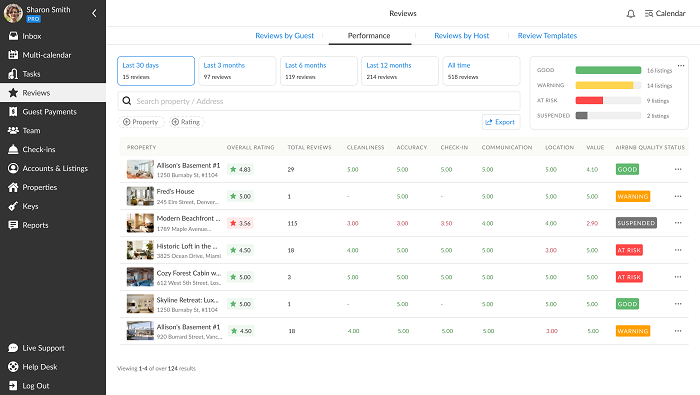
Hosts can also check the Airbnb Quality Status for each listing in Reviews → Performance, where listings are categorized as Good, Warning, At Risk, or Suspended. This makes it easy to quickly identify which properties are performing well and which ones may need improvement.
For deeper insights, hosts can also export detailed review data, including category ratings such as cleanliness, communication, value, accuracy, location, and check-in, as well as negative feedback tags. This data can help identify trends and areas for improvement across your listings.
Practical Tips to Maintain High Airbnb Ratings
Tracking performance is only the first step. The key to maintaining strong ratings is using those insights to improve the guest experience consistently.
1. Monitor Your Reviews Regularly
Reviews are one of the most reliable indicators of guest satisfaction, so it is worth building a consistent habit of checking them rather than waiting for a ratings dip.
Review your performance regularly and look at trends over time so you can spot early signals, such as a gradual decrease in 5-star reviews, repeated complaints about the same issue, or a slow decline in category scores.
When you catch patterns early, you can resolve problems before they impact your listing's overall standing.
2. Pay Close Attention to Category Ratings
Many hosts focus on the overall score, but category ratings usually reveal why the overall score is trending up or down. If your communication rating is slipping, the fix may be as simple as faster responses, clearer instructions, or more proactive messaging before arrival.
If accuracy drops, it often means the listing description or photos no longer match what guests experience in the space.
If cleanliness ratings trend downward, it typically points to inconsistency in the cleaning process or missed details.
A useful approach is to review category performance monthly and make at least one targeted improvement based on the lowest-scoring category.
3. Address Issues Before They Escalate
If a listing starts showing warning signs (declining ratings, recurring negative feedback, or repeated mentions of the same pain point), treat it as a signal to act immediately.
Often, the highest-impact changes are straightforward: refresh outdated photos so expectations match reality, strengthen check-in instructions to reduce confusion, fix maintenance issues as soon as they appear, and replace worn linens or tired furnishings before guests start calling them out in reviews.
If "value" feedback becomes more common, review whether your pricing aligns with your current condition, amenities, and competitive set. Small operational upgrades made quickly can prevent bigger reputation damage later.

4. Improve the Check-In Experience
Check-in is one of the most frequently mentioned parts of the guest experience, and a smooth arrival sets the tone for the entire stay.
Make check-in as simple and stress-free as possible by providing clear, step-by-step instructions that answer the questions guests typically face in the moment: how to access the building, where to park, which entrance to use, and what to do if something does not work.
Send instructions in advance so guests don't have to search for details while traveling, and consider smart locks or lockboxes where possible to reduce friction and late-night support messages.
5. Maintain Consistent Cleaning Standards
Cleanliness remains one of the strongest drivers of Airbnb ratings, and consistency is what guests notice most.
Standardize your cleaning process with a detailed checklist to ensure consistent results from one turnover to the next.
Add periodic inspections (even quick spot-checks) to catch repeated misses early, and replace damaged or worn items promptly so the home feels cared for.
Pay special attention to kitchens and bathrooms, where even minor issues tend to stand out and appear in reviews.
6. Use Guest Feedback to Improve Your Listings
Guest feedback becomes truly valuable when you look for trends rather than reacting to isolated comments. As you review feedback, focus on repeated suggestions or recurring friction points and ask what is driving them:
- Is something unclear in the listing or guidebook?
- Are guests expecting an amenity you do not provide?
- Is there an operational gap you can close with better supplies, labeling, or instructions?
When you consistently address repeated feedback, you not only improve future reviews but also reduce the likelihood that the same issue will recur.

7. Keep Your Listing Information Accurate
Many negative reviews happen because the listing does not match expectations, even if the property is objectively fine.
Keep your listing accurate and up to date by clearly describing the property's size and layout, available amenities, house rules, parking details, and any limitations, such as stairs, potential noise, or other constraints.
Update your photos and description whenever you make changes to the space, remove an amenity, or adjust access procedures.
When guests know what to expect, they are far more likely to feel satisfied and less likely to penalize you in ratings.
8. Encourage Guests to Leave Reviews
A healthier review volume makes your rating more stable and gives you better insight into what guests value most. After checkout, send a short, friendly message thanking guests for staying and inviting them to share feedback about their experience.
Keeping it warm and simple increases the chance they will follow through. More reviews also help you spot trends faster, because you are not relying on a small sample size to judge performance.
9. Use Data to Identify Long-Term Trends
Individual reviews are helpful, but long-term data is what allows you to improve systematically, especially if you manage multiple listings.
By analyzing exported review data, category scores, and negative feedback tags, you can uncover patterns that are not obvious from single reviews.
This might include recurring operational issues, gaps in cleaning team performance, amenities guests frequently request, or specific listings that repeatedly show early warning signals.
Using data this way helps you prioritize fixes with the greatest impact and maintain consistent quality across your portfolio.
Final Thoughts
Maintaining high Airbnb ratings is not about perfection; it is about consistency. Hosts who regularly monitor performance, respond to guest feedback, and make small improvements over time are much more likely to maintain strong ratings and satisfied guests.
With the new Airbnb quality-tracking tools in iGMS, hosts can stay proactive, identify issues earlier, and ensure their listings continue to deliver excellent guest experiences.